
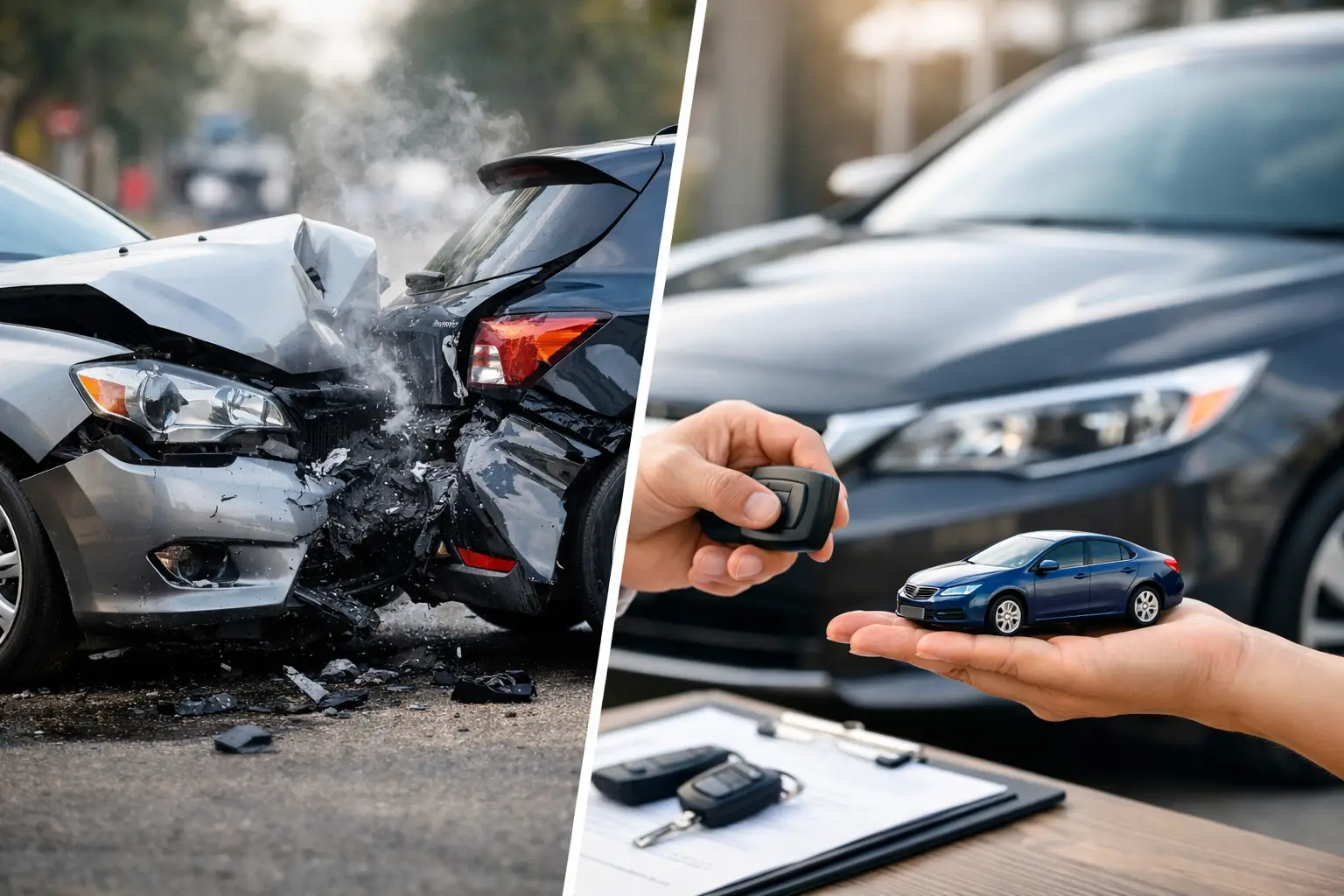
A vehicle can be damaged in a split second, but the reason for the damage determines which part of your policy may respond. Understanding collision versus comprehensive coverage helps you build protection around the risks your vehicle actually faces, rather than discovering a gap after a loss.
These coverages are often grouped together because both pay for damage to your own vehicle. Yet they are designed for different events. Collision addresses impact-related damage. Comprehensive, formally called other-than-collision coverage by many insurers, addresses many losses that happen outside a driving collision. The distinction matters when you select deductibles, assess a vehicle's value, or decide how much financial risk to retain.
Collision Versus Comprehensive Coverage: The Core Difference
Collision coverage generally pays to repair or replace your covered vehicle after it strikes another vehicle or an object, or after it overturns. A sideswipe in a parking lot, backing into a pole, hitting a guardrail, and rolling over on an icy road are common collision scenarios. It can also apply when another driver causes an accident but their liability coverage is unavailable, insufficient, or still being resolved.
Comprehensive coverage applies to covered damage caused by events other than a collision. Think of a cracked windshield from road debris, hail damage, theft, vandalism, a falling tree limb, fire, flood, or an animal strike. If a deer runs into your vehicle, comprehensive is generally the coverage designed for that claim. If you steer to avoid the deer and hit a tree, the resulting impact is generally a collision claim.
The line can feel technical, but it reflects a deliberate coverage structure. Collision protects against the physical force of an impact or rollover. Comprehensive protects against a broader set of sudden, external threats that can damage, destroy, or remove a vehicle without a conventional crash.
What Each Coverage Can Pay For
Both coverages are intended to protect the vehicle itself, subject to the policy terms, your deductible, and the vehicle's value. They do not simply provide an open-ended repair budget. An insurer commonly evaluates the cost to repair the vehicle against its actual cash value immediately before the loss. If repairing the vehicle costs too much relative to its value, it may be declared a total loss.
With a covered collision claim, payment may help repair body damage, replace damaged parts, or settle a total loss after your deductible. With a covered comprehensive claim, payment may address storm damage, broken glass, stolen vehicle losses, or damage from a covered falling object, again after the applicable deductible.
Actual cash value is a critical concept. A policy generally pays based on the vehicle's market value at the time of loss, not necessarily what you originally paid, what you still owe on a loan, or what it would cost to buy a brand-new replacement. A vehicle with a loan or lease may need additional planning, particularly if its outstanding balance could exceed its insured value after a total loss.
A simple claim example
Assume your vehicle has a $1,000 collision deductible and sustains $6,500 in covered damage after you slide into a concrete barrier. If the vehicle can be repaired and the loss is covered, the policy would generally pay $5,500 toward the repair, subject to policy conditions.
Now consider a hailstorm that causes $6,500 in damage. If your comprehensive deductible is $500, the policy would generally pay $6,000 for a covered claim. The event is different, and so is the coverage category and deductible that apply.
Deductibles Are a Financial Design Decision
A deductible is the amount you agree to pay out of pocket before coverage contributes to a covered loss. Collision and comprehensive deductibles are usually selected separately. You might choose a $1,000 collision deductible and a $250 comprehensive deductible, or another combination that fits your financial capacity and risk tolerance.
Higher deductibles can reduce the premium, but they also transfer more loss responsibility back to you. That trade-off deserves more attention than it often receives. A deductible should be an amount you could pay without destabilizing your household budget at an already stressful moment.
Comprehensive deductibles are often lower because a windshield claim, animal strike, or weather-related loss can be meaningful but may not carry the same repair costs as a major crash. Still, the right structure depends on your vehicle, your savings, local weather and theft exposure, and how you use the vehicle. There is no universally correct deductible.
Some policies offer separate glass provisions or reduced glass deductibles in certain circumstances. These details vary by policy and state. A cracked windshield may look like a straightforward loss, but the applicable deductible and repair options should be confirmed before assuming the cost will be fully covered.
What Collision and Comprehensive Do Not Replace
Collision and comprehensive are valuable components of auto protection, but they are not a substitute for the rest of the policy. They generally do not pay for injuries you cause to others, damage you cause to another person's property, routine maintenance, mechanical breakdown, normal wear, or depreciation.
They also do not guarantee every loss is covered. Policies contain exclusions, conditions, and duties after a loss. Intentional damage, racing-related losses, unapproved vehicle use, or losses involving policy misrepresentation may fall outside coverage. Personal property stolen from a vehicle may be addressed differently from theft of the vehicle itself and could involve a separate policy.
Rental reimbursement, towing, roadside assistance, new-car replacement, and loan or lease payoff protection are also separate considerations. They may be available by endorsement or optional coverage, but they should not be assumed to be included with collision or comprehensive coverage.
When Keeping Both Coverages Makes Sense
For financed and leased vehicles, lenders and leasing companies commonly require both collision and comprehensive coverage. Their interest is straightforward: the vehicle securing the agreement needs protection against major physical damage or total loss. Even after a loan is paid off, the decision should be based on your own ability to replace or repair the vehicle.
Keeping both often makes sense when the vehicle has meaningful market value, when replacement would strain your finances, or when you rely heavily on it for work, family responsibilities, or daily transportation. A newer vehicle is not the only reason to carry physical damage coverage. A well-maintained older vehicle can still represent a substantial financial asset.
There are situations where reducing or dropping coverage may be reasonable. If a vehicle's actual cash value is low, the premium and deductible may approach the amount an insurer could pay after a total loss. If you have enough savings to absorb replacement and are comfortable retaining that risk, carrying less physical damage coverage may be a considered choice.
That decision should not be driven by vehicle age alone. Ask a more useful question: if this vehicle were stolen, totaled in a storm, or damaged in an accident tomorrow, could you replace it without borrowing, delaying essential expenses, or compromising other financial priorities? The answer reveals the exposure more clearly than a rule of thumb.
Build Coverage Around the Vehicle You Own
A sound auto policy is not assembled by checking every available box or by choosing the lowest premium. It is designed around the value of the vehicle, the cost of disruption, the risks in your environment, and the amount you can responsibly retain after a loss.
Review the declared vehicle information, coverage limits, deductibles, loan or lease obligations, and optional endorsements at least once a year and after a major life change. A move, a newly paid-off loan, a different commute, a teen driver, or a substantial change in the vehicle's condition can alter the protection you need.
Collision and comprehensive coverage work best when they are part of a coherent architecture of protection: clear assumptions, realistic deductibles, and no reliance on coverage that was never selected. The most useful policy is the one whose design still makes sense on the day you need to use it.