
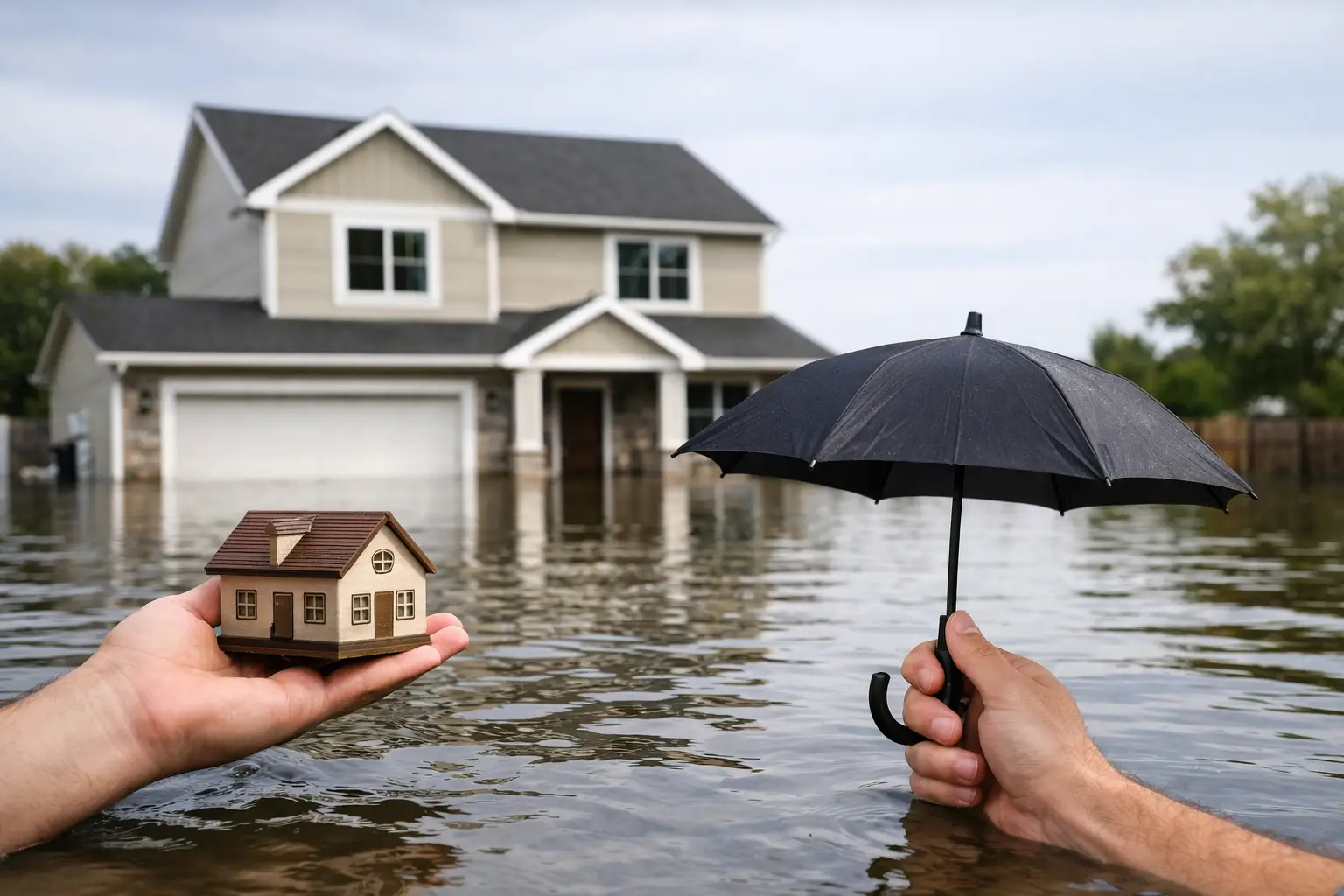
A home can sit outside the familiar high-risk flood zone and still suffer a costly water loss. That is why the question is not simply whether flood insurance required rules apply to your mortgage. The more useful question is whether your current protection can absorb the financial consequences of flooding where you live, own, or keep valuable property.
Most standard homeowners, renters, and condominium policies do not cover damage caused by flood. They may respond to a burst pipe or wind-driven rain that enters through a damaged roof, but rising water from outside the property is generally treated differently. That distinction can leave an otherwise well-insured household exposed at precisely the moment protection matters most.
When Is Flood Insurance Required?
Federal law generally requires flood insurance when a property securing a mortgage is located in a Special Flood Hazard Area, commonly called an SFHA or high-risk flood zone, and the loan is made, backed, or regulated by a federally regulated lender. This often includes conventional mortgages serviced by major financial institutions, as well as many government-backed loans.
The requirement is tied to the property and the loan, not to whether the owner believes flooding is likely. Lenders use FEMA flood maps and a flood-zone determination to identify whether the structure serving as collateral falls within the designated area. If it does, proof of flood coverage is typically required before closing and must remain in place for the life of the loan.
The required amount is not always the same as the home’s full replacement cost. In general, the lender requires coverage at least equal to the lesser of the outstanding loan balance, the maximum available under the applicable program, or the insurable value of the building. Those rules establish a minimum. A minimum, however, is not automatically a complete protection design.
A requirement can arise after closing
Flood insurance is not only a closing-day issue. FEMA maps can change, and lenders periodically review flood-zone information. If a property is newly identified within a Special Flood Hazard Area during the loan term, the lender can notify the borrower and require coverage within a specified period.
Likewise, a lapse in coverage can create an urgent problem. If required insurance is not obtained, a lender may purchase coverage on the borrower’s behalf and charge for it. This lender-placed coverage is designed to protect the lender’s collateral interest. It may be more expensive, narrower than a carefully selected policy, and may not protect personal belongings or additional living costs in the way a household expects.
A FEMA Zone Is Not a Personal Risk Score
Flood maps are valuable planning tools, but they are not a promise that water will stay within mapped boundaries. They identify areas with certain modeled flood risks, often based on historical data, elevation, drainage patterns, coastal conditions, and river systems. They do not eliminate the possibility of intense rainfall, overwhelmed storm drains, development-related runoff, or changing weather patterns elsewhere.
This is why a property outside a high-risk zone may not be subject to a lender mandate but can still have a meaningful need for flood protection. In fact, many flood losses occur outside the highest-risk mapped areas. A mortgage requirement is a regulatory threshold. It should not be mistaken for a complete assessment of exposure.
For a property owner, the practical review goes beyond the map designation. Consider the grade around the home, proximity to creeks or drainage channels, nearby construction, prior street flooding, basement or ground-level living space, and the cost to replace finished surfaces, systems, and belongings. A few inches of water can damage flooring, drywall, insulation, appliances, and electrical components quickly.
What Flood Coverage Is Designed to Protect
Flood policies vary, particularly between government-backed and private options, so the policy form deserves close attention. The central question is not merely whether a policy exists. It is whether its limits, deductibles, property definitions, and exclusions fit the asset at risk.
For a primary residence, building coverage commonly addresses the physical structure and certain permanently installed items, such as electrical and plumbing systems, furnaces, water heaters, and built-in appliances. Contents coverage may need to be selected separately and can apply to personal belongings such as furniture, clothing, electronics, and other household property.
Basements require especially careful review. Coverage for items below the lowest elevated floor or in a basement may be limited, even when those items were expensive to install. Finished walls, flooring, and many personal possessions may not be treated the same as essential building equipment. A lower-level family room, storage area, or workshop should never be assumed to be fully protected without reading the applicable policy terms.
Condominium ownership also calls for coordination. A condominium association may insure portions of the building, while the unit owner remains responsible for interior improvements, personal property, and potential assessment exposure. The governing documents and master policy shape that boundary. A unit owner policy should be designed with those responsibilities in mind rather than purchased on the assumption that the association policy covers everything.
Renters do not insure the building itself, but they can still face substantial loss when floodwater damages furniture, clothing, electronics, and other personal property. For them, the issue is less about a lender’s mandate and more about whether replacing what they own would create a financial setback.
Required Coverage Is a Floor, Not the Finished Structure
A lender may be satisfied with a policy limit that protects its loan balance. The homeowner may need more. If rebuilding costs, building upgrades, detached structures, or valuable belongings exceed the required amount, the household can remain underinsured despite meeting the loan condition.
Deductibles deserve the same discipline. A higher deductible can reduce premium cost, but it shifts more of the immediate financial burden back to the policyholder. That trade-off may be reasonable for a household with accessible reserves. It is less comfortable when a water event could also interrupt housing, require cleanup, and force replacement purchases at the same time.
The source of coverage matters as well. Some properties are insured through a government-backed flood policy, while others may qualify for private flood coverage. Availability, limits, waiting periods, and policy features can differ. Certain lenders may accept a qualifying private policy, but the lender’s requirements and policy language should be confirmed before relying on that approach.
A common timing issue is the waiting period. Flood coverage often does not begin immediately after purchase, although exceptions may apply for a new mortgage closing, a map revision, or other specific circumstances. Waiting until a storm is approaching is rarely an effective protection strategy. By then, carriers may restrict new policies, and the loss may already be foreseeable.
How to Make a Clear Flood Insurance Decision
Start with the lender question: Is the property in a Special Flood Hazard Area, and does the loan require coverage? Then move to the protection question: What would it cost to repair the structure and replace the contents if outside water entered the property?
Gather the mortgage details, current declarations pages, flood-zone designation, estimated rebuilding cost, and a realistic inventory of belongings. For condominium owners, include the association documents and master policy information. These documents reveal where one policy ends and another should begin.
Then examine the gaps. Does the current policy exclude flood? Is the building limit aligned with today’s repair costs? Are personal belongings covered? Is the deductible manageable? Does the lower level contain property that may face limited coverage? Each answer helps turn a broad concern into a deliberate coverage design.
Shield Pro Insurance approaches these decisions as part of the Architecture of Protection: a coordinated structure built around the property, the financial stakes, and the gaps that can otherwise remain hidden in policy language. The goal is not to buy coverage because a map or lender says so. It is to make sure the protection around what you have built can hold when water does not follow the expected path.
A flood requirement may begin with a lender notice, but sound preparation should not end there. Review the exposure while there is time to make thoughtful choices, because the best moment to understand a flood policy is long before water reaches the door.